
Blog
How to Choose Bathroom Storage
How to Choose Bathroom Storage That Actually Works for Your Space
Bathroom storage is one of those purchases that looks simple until you start using it every day. A cabinet may look neat in product photos, but if it blocks a doorway, holds fewer items than expected, or cannot handle bathroom humidity, congratulations, you have bought yourself a decorative inconvenience.
The best way to choose bathroom storage is to start with the room layout, then compare cabinet size, storage capacity, material, door clearance, installation needs, and cleaning effort. Style matters, but only after the cabinet proves it can fit your space and hold the items you actually use.
This guide explains how to choose bathroom storage for homeowners, apartment owners, families, and first-time buyers. It also uses the Cittaneo ETNA-305 Bathroom Side Cabinet as a practical example of a compact bathroom side cabinet for buyers comparing slim storage options.

Quick Buying Conclusion: What to Check First
If you are close to buying, focus on fit, capacity, and access. Bathroom storage should make daily routines easier, not create another obstacle between you and your towel.
- Best for small bathrooms: Slim side cabinets, wall cabinets, over-toilet cabinets, and narrow floor cabinets.
- Best for families: Larger cabinets with adjustable shelves, closed storage, and enough room for towels, toiletries, and cleaning supplies.
- Best for renters: Freestanding storage that does not require major wall changes, unless your lease allows mounting.
- Avoid if: the cabinet blocks doors, vents, drawers, shower access, or toilet clearance.
The three most important buying factors are size, moisture-friendly construction, and usable interior layout. Before ordering, confirm the product dimensions, available floor space, door swing, shelf configuration, material, finish, delivery path, and return conditions.
How to Choose Bathroom Storage by Type
Bathroom storage comes in several forms, and each one solves a different problem. The right choice depends on whether you need hidden storage, open access, towel storage, cleaning supply storage, or a decorative piece that also does useful work. Humanity survives another cabinet decision, somehow.
| Storage Type | Main Advantage | Main Limitation | Best For |
|---|---|---|---|
| Bathroom Side Cabinet | Adds vertical storage beside a vanity, toilet, or wall | Floor space and door clearance must be checked | Small bathrooms, guest baths, apartments, powder rooms |
| Wall-Mounted Cabinet | Saves floor space and keeps items off the counter | Requires secure wall mounting | Compact bathrooms and modern layouts |
| Over-Toilet Cabinet | Uses vertical space that is often wasted | Can feel bulky if the room is narrow | Bathrooms with limited floor space |
| Linen Cabinet | Stores towels, larger items, and backup supplies | Needs more wall and floor space | Family bathrooms and primary bathrooms |
| Open Shelving | Easy access and lighter visual feel | Items are exposed to dust and visual clutter | Decorative storage, guest towels, baskets |
| Vanity Storage | Combines sink function with hidden storage | Plumbing can reduce usable cabinet space | Bathrooms needing both sink and storage upgrade |
Size and Space: The First Rule of Bathroom Storage
Size is the first thing to check because bathroom storage often sits in tight areas. A cabinet can be technically small and still be too large if it blocks a door, reduces walking space, or makes the toilet area uncomfortable.
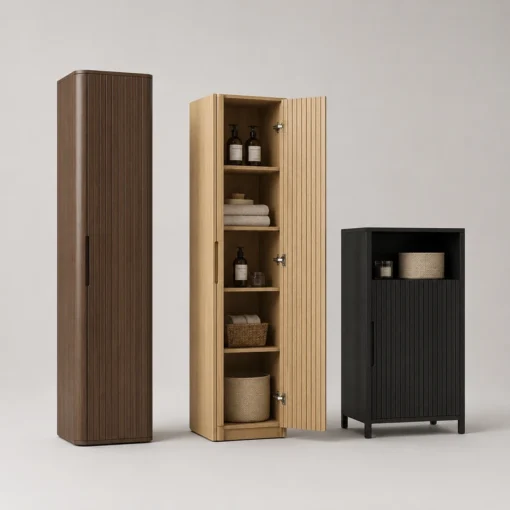
The Cittaneo ETNA-305 Bathroom Side Cabinet is listed as a bathroom storage product with dimensions of 14.17 × 11.41 × 29.5 inches, walnut color, engineered wood material, and a weight listed in the additional information section as 52.24 lbs. It also lists features such as a push-open door and two adjustable shelves. :contentReference[oaicite:0]{index=0}
Those dimensions make it a compact side cabinet category option, but buyers should still measure carefully. A cabinet that is narrow on paper can still feel awkward if placed beside a toilet, next to a vanity drawer, or near a swinging bathroom door.
Measure These Areas Before Buying
- Floor footprint: Confirm the cabinet width and depth against the actual available floor area.
- Walking path: Leave enough room to move comfortably around the cabinet.
- Door swing: Check whether the cabinet door can open fully.
- Bathroom door clearance: Make sure the main door, shower door, or closet door will not hit it.
- Delivery route: Measure narrow hallways, stairs, elevators, and bathroom entryways.
Storage Capacity: Think About What You Actually Need to Store
The right cabinet is not always the largest one. It is the one that stores your real bathroom items in a way that makes sense. A family bathroom may need space for towels, extra toilet paper, hair products, cleaning supplies, and children’s bath items. A powder room may only need hand towels, spare soap, and a few guest essentials.
Adjustable shelves can be useful because bathroom products vary wildly in height. Tall bottles, folded towels, cleaning sprays, and baskets do not all fit the same shelf spacing. The ETNA-305 lists two adjustable shelves, which may help buyers customize the interior for different everyday items.
Closed Storage vs. Open Storage
Closed storage is better for hiding visual clutter, cleaning products, and backup supplies. Open storage works well for towels, baskets, and decorative items, but it demands tidiness. If your daily routine already looks like a small toiletries explosion, closed storage is probably your friend.
Material and Finish: What Matters in a Bathroom
Bathrooms are tough on furniture. Moisture, steam, splashes, cleaning products, and temperature changes can affect cabinet surfaces over time. That does not mean every bathroom cabinet must be built like a submarine, but it does mean material and finish should not be ignored.
The ETNA-305 product page lists the material as engineered wood. Engineered wood is common in bathroom furniture because it can offer a smooth, consistent surface and a designed finish. Buyers should still keep bathroom furniture dry when possible, wipe spills promptly, and follow the cleaning instructions for the specific product.
Useful Material Questions to Ask
- Is the surface suitable for humid bathroom environments?
- Does the finish wipe clean easily?
- Are the shelves strong enough for the items you plan to store?
- Are the edges, seams, and corners easy to clean?
- Will the color match your vanity, mirror, flooring, and wall color?
Installation and Placement: Do Not Treat Storage Like Decoration
Bathroom storage must work with the room, not just sit inside it. Placement affects comfort, safety, and cleaning. A cabinet placed too close to the toilet may feel cramped. A cabinet too close to the shower may collect more moisture. A cabinet next to a vanity may block drawers or make the sink area feel crowded.
Freestanding side cabinets are often easier to place than built-in options, but buyers should still check stability, floor level, and whether anti-tip hardware or wall anchoring is recommended. Installation requirements may differ by model, so review the product specifications and instructions before purchase.
Good Placement Options
- Beside a bathroom vanity, if drawer and door clearance allows.
- Near the toilet, if there is enough legroom and walking space.
- Against an empty wall where it does not block traffic.
- Inside a larger bathroom corner for towel and toiletry storage.
- In a laundry bathroom or guest bath where compact storage is needed.
Which Bathroom Storage Features Are Worth Paying For?
Some features improve daily use. Others mostly sound nice in product descriptions, because apparently cabinets need dramatic personalities now. Here is how to judge what is worth extra budget.
Necessary Features
- Correct size: The cabinet must fit the room and leave usable clearance.
- Stable structure: Bathroom storage should feel secure when loaded.
- Moisture-conscious finish: Surfaces should handle normal bathroom humidity and cleaning.
- Usable shelves: Shelf spacing should work for towels, bottles, and daily supplies.
Features That Improve Daily Use
- Adjustable shelves: Helpful for storing items of different heights.
- Push-open doors: Useful for a clean, handle-free look and easy access.
- Rounded or softened corners: Helpful in tight bathrooms where sharp corners can feel intrusive.
- Closed cabinet design: Keeps clutter hidden and makes the bathroom look calmer.
Features That Depend on Your Space
Decorative stripes, walnut finishes, handle-free fronts, and curved edges can be worth paying for if the cabinet is visible and contributes to the bathroom design. If the cabinet will sit in a hidden laundry corner, prioritize capacity and durability first. Beauty is nice. Storage that actually stores things is better.
Budget and Long-Term Cost
The cost of bathroom storage is not just the purchase price. Buyers should also consider delivery, assembly, installation tools, wall anchoring, cleaning products, replacement hardware, and the cost of returning or replacing an item that does not fit.
Entry-level storage usually focuses on basic shelves and simple finishes. Mid-range storage often adds better design, smoother doors, stronger finishes, or more flexible interior layouts. Premium storage may include higher-end materials, larger capacity, refined hardware, or more furniture-like detailing.
If your bathroom is small, a compact side cabinet can be a smarter purchase than a large linen cabinet. It may solve the main storage problem without overwhelming the room. If your bathroom serves a family, however, buying too little storage can lead to clutter returning within a week, because shampoo bottles reproduce when unsupervised.
Pros and Cons of a Compact Bathroom Side Cabinet
A compact side cabinet like the ETNA-305 can be practical, but it is not the right answer for every bathroom.
| Pros | Why It Helps |
|---|---|
| Compact footprint | Useful for small bathrooms, apartments, guest baths, and powder rooms. |
| Closed storage | Helps hide toiletries, extra supplies, and visual clutter. |
| Adjustable shelves | Allows more flexible storage for different item heights. |
| Walnut finish | Adds warmth and can coordinate with wood-tone bathroom vanities. |
| Push-open door design | Creates a clean look without visible handles. |
| Cons | Who Should Be Careful |
|---|---|
| Limited capacity compared with larger cabinets | Families storing many towels and bulk supplies may need more space. |
| Floor space required | Very narrow bathrooms may be better served by wall storage. |
| Door clearance must be checked | Small bathrooms with tight corners may limit access. |
| Wood-look finish needs care | Buyers should wipe water and cleaning residue promptly. |
| Style may not match every bathroom | Walnut may not suit bathrooms with cool gray, white-only, or chrome-heavy designs. |
Common Bathroom Storage Buying Mistakes
- Only measuring the empty wall. Measure the full usable area, including walking space, door swing, toilet clearance, and nearby vanity drawers.
- Buying storage that is too shallow or too narrow for real items. Check what you plan to store before choosing the cabinet size.
- Ignoring shelf adjustability. Fixed shelves can be frustrating if your bottles, towels, or baskets do not fit.
- Choosing open shelves when you dislike clutter. Pick closed storage if you want the bathroom to look clean with less effort.
- Forgetting moisture exposure. Avoid placing bathroom furniture where it will be constantly splashed or soaked.
- Assuming the color will look identical in your room. Lighting, wall color, and flooring can change how walnut, white, gray, or black finishes appear.
- Skipping installation details. Check whether assembly, wall anchoring, or anti-tip hardware is recommended.
- Not reviewing return conditions. Large or heavy bathroom furniture can be costly and inconvenient to return.
Who Should Buy This Type of Bathroom Storage?
Good Fit For
- Homeowners upgrading a small or medium bathroom.
- Apartment owners who need extra storage without a full remodel.
- Families needing a place for spare toiletries, hand towels, and daily supplies.
- First-time buyers who want simple, closed bathroom storage.
- People who like a warm walnut finish and a clean handle-free look.
Consider Another Option If
- You need to store many full-size bath towels or large cleaning supplies.
- Your bathroom has no safe floor space for a side cabinet.
- You prefer wall-mounted storage to keep the floor open.
- You need a cabinet that matches an existing white, gray, or black vanity exactly.
Not Recommended If
- You cannot confirm the cabinet dimensions will fit your space.
- The cabinet would block a door, vent, shower entry, or walking path.
- You need waterproof storage for areas with constant direct water exposure.
- You want large-capacity linen storage for a busy family bathroom.
Bathroom Storage Buying Checklist
Use this checklist before placing your order. It is not exciting, which is exactly why it prevents expensive mistakes.
- Confirm the product dimensions.
- Measure the available floor or wall space.
- Check bathroom door, cabinet door, vanity drawer, toilet, and shower clearance.
- Decide what you need to store: towels, toiletries, cleaning supplies, paper goods, or guest items.
- Confirm whether shelves are adjustable or fixed.
- Check the cabinet material and finish.
- Review cleaning and maintenance requirements.
- Confirm assembly or installation requirements.
- Check whether wall anchoring or anti-tip support is recommended.
- Measure the delivery path through doors, stairs, hallways, and elevators.
- Review delivery, cancellation, and return conditions before ordering.
FAQ: How to Choose Bathroom Storage
What type of bathroom storage is best for a small bathroom?
A slim side cabinet, wall-mounted cabinet, or over-toilet cabinet is usually best for a small bathroom. The right choice depends on your floor space and wall space. If you have an unused corner or space beside a vanity, a compact side cabinet can add storage without requiring a full remodel.
Is closed bathroom storage better than open shelving?
Closed storage is better if you want to hide clutter, cleaning supplies, and backup toiletries. Open shelving is better for quick access, towels, and decorative baskets. For most everyday bathrooms, a mix works well, but closed storage is usually easier to keep looking tidy.
Are adjustable shelves worth it in a bathroom cabinet?
Yes, adjustable shelves are useful because bathroom items come in many sizes. Tall bottles, folded towels, cleaning sprays, and baskets may need different shelf heights. Adjustable shelves make the cabinet more flexible over time, especially if your storage needs change.
Can engineered wood work in bathroom storage?
Engineered wood can work in bathroom furniture when the finish is suitable for normal bathroom use and the cabinet is maintained properly. Buyers should avoid constant soaking, wipe up water quickly, and follow the care instructions for the specific product. Placement away from direct splashing also helps.
How much bathroom storage do I need?
Start by listing what you actually store in the bathroom. A powder room may only need hand towels and spare soap, while a family bathroom may need towels, toiletries, cleaning supplies, paper goods, and backup products. Choose storage based on real items, not just how empty the cabinet looks online.
What should I check before buying bathroom storage online?
Check dimensions, material, finish, shelf layout, door clearance, assembly needs, delivery path, and return conditions. Photos help you judge style, but specifications decide whether the cabinet fits and functions well in your bathroom.
Final Buying Advice: How to Choose Bathroom Storage With Fewer Regrets
The best way to choose bathroom storage is to match the cabinet to your room first and your routine second. If your bathroom is small, prioritize a slim footprint, door clearance, and vertical storage. If your bathroom serves a family, prioritize capacity, adjustable shelves, and closed storage that can hide everyday clutter.
If you want compact bathroom storage with a warm wood look, the Cittaneo ETNA-305 Bathroom Side Cabinet is a practical option to compare. Its listed dimensions, walnut finish, engineered wood material, push-open door, and adjustable shelves make it relevant for buyers looking at slim side cabinets. Still, the final decision should come down to your measurements, storage needs, bathroom layout, and maintenance expectations.
Explore the available options and compare the specifications that matter most for your bathroom. Choose the storage piece that fits your space, holds your real daily items, and does not make the room harder to use. That is the entire point of storage, despite what overexcited product photography may suggest.